The value of a shipment of apples reaching a buyer six months after harvest depends entirely on what kind of storage those apples sat in for those six months. Here's the technical and practical difference between regular cold storage and controlled atmosphere (CA) storage.
How regular cold storage works
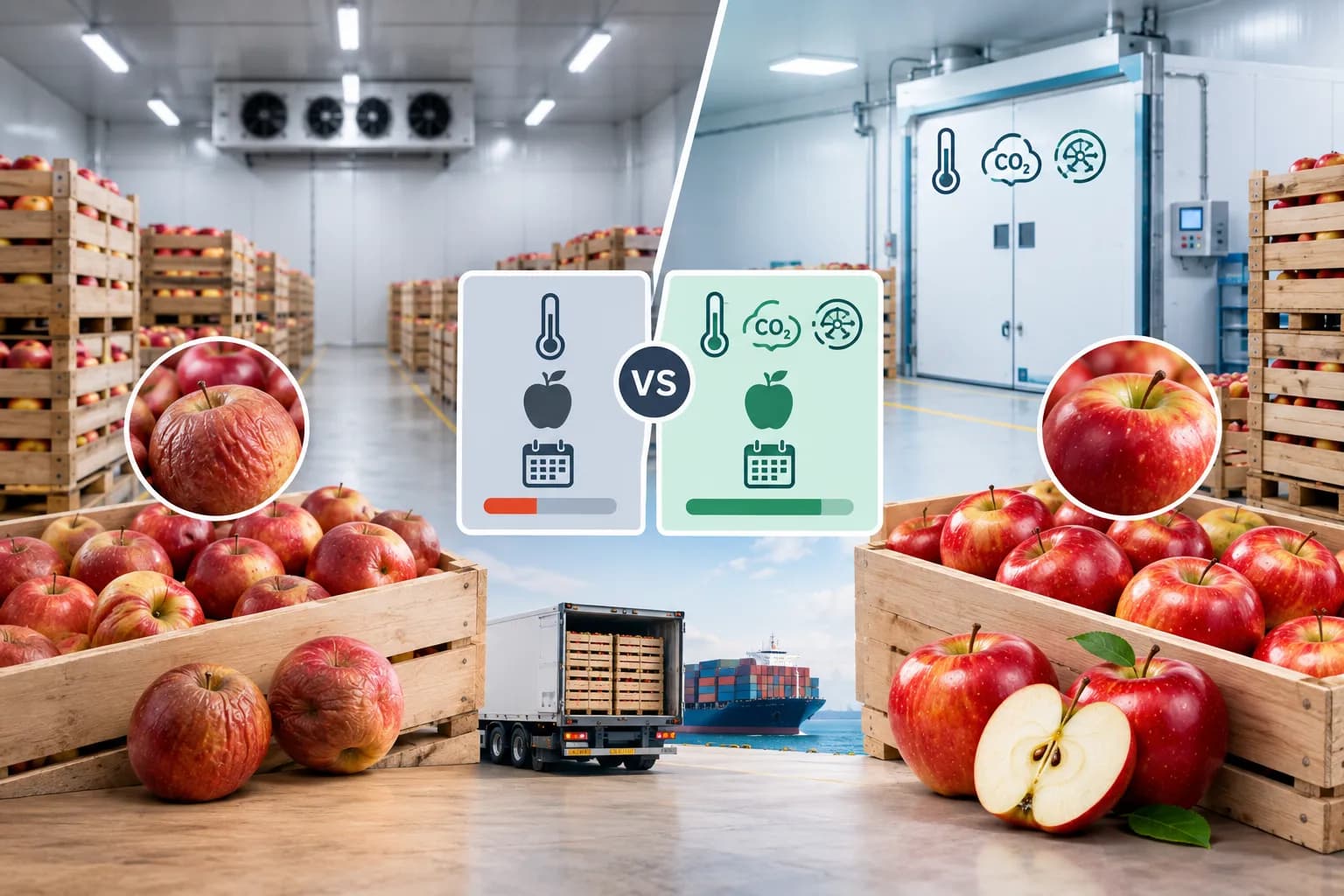
Regular cold storage only controls temperature and humidity. After harvest, fruit keeps respiring — consuming oxygen and releasing carbon dioxide — and that process is what drives gradual ripening, softening, and quality loss. Cold slows this process down, but it doesn't stop it.
What CA storage actually is
Controlled atmosphere storage regulates oxygen and carbon dioxide levels inside the room precisely, on top of temperature and humidity. Oxygen is typically reduced to around 1–2%, carbon dioxide is held between 1–5%, temperature stays around 0–2آ°C, and relative humidity is kept at 90–95%. Lowering oxygen dramatically slows the fruit's respiration rate.
The real difference in shelf life
Apples in regular cold storage typically hold export quality for two to four months. In CA storage, the same apples can hold their taste, firmness, and appearance for eight to twelve months, depending on the variety.
Why this matters for an exporter
Off-season selling: an exporter with CA storage can sell September-harvested apples the following spring at near-fresh quality, usually at a better price since market supply has thinned out.
Less waste: slower quality decline means a smaller share of the shipment falls out of grade during storage.
Longer-term contracts become possible: an international buyer looking for a multi-month supply contract needs assurance that quality will hold steady over time — CA storage provides exactly that.
Something worth knowing: not every variety behaves the same
The optimal CA settings — exact oxygen and CO2 levels — vary by apple variety; some varieties are sensitive to high CO2 and can be damaged if the atmosphere isn't tuned correctly. That takes a gas-monitoring system and someone who actually knows the variety being stored.
Cost versus the payoff
Building and running a CA facility costs more than regular cold storage, since it needs gas-control equipment and constant monitoring. But for a shipment that isn't going to sell in the first few weeks after harvest, that cost is usually offset by the better price it fetches later in the season.
Where Oriex fits in
Every supplier profile on Oriex shows whether they have regular or CA storage, and its capacity, so a buyer can pick the right supplier based on their own timeline — a quick shipment versus a multi-month supply contract. If you own cold storage, take a look at signing up on Oriex.