Many exporters assume packaging is a single fixed standard worldwide. In practice, pallet requirements, labeling rules, and quality grading differ significantly between markets — and getting them wrong can stop a shipment at customs entirely.
Wooden pallets and crates: the ISPM 15 requirement
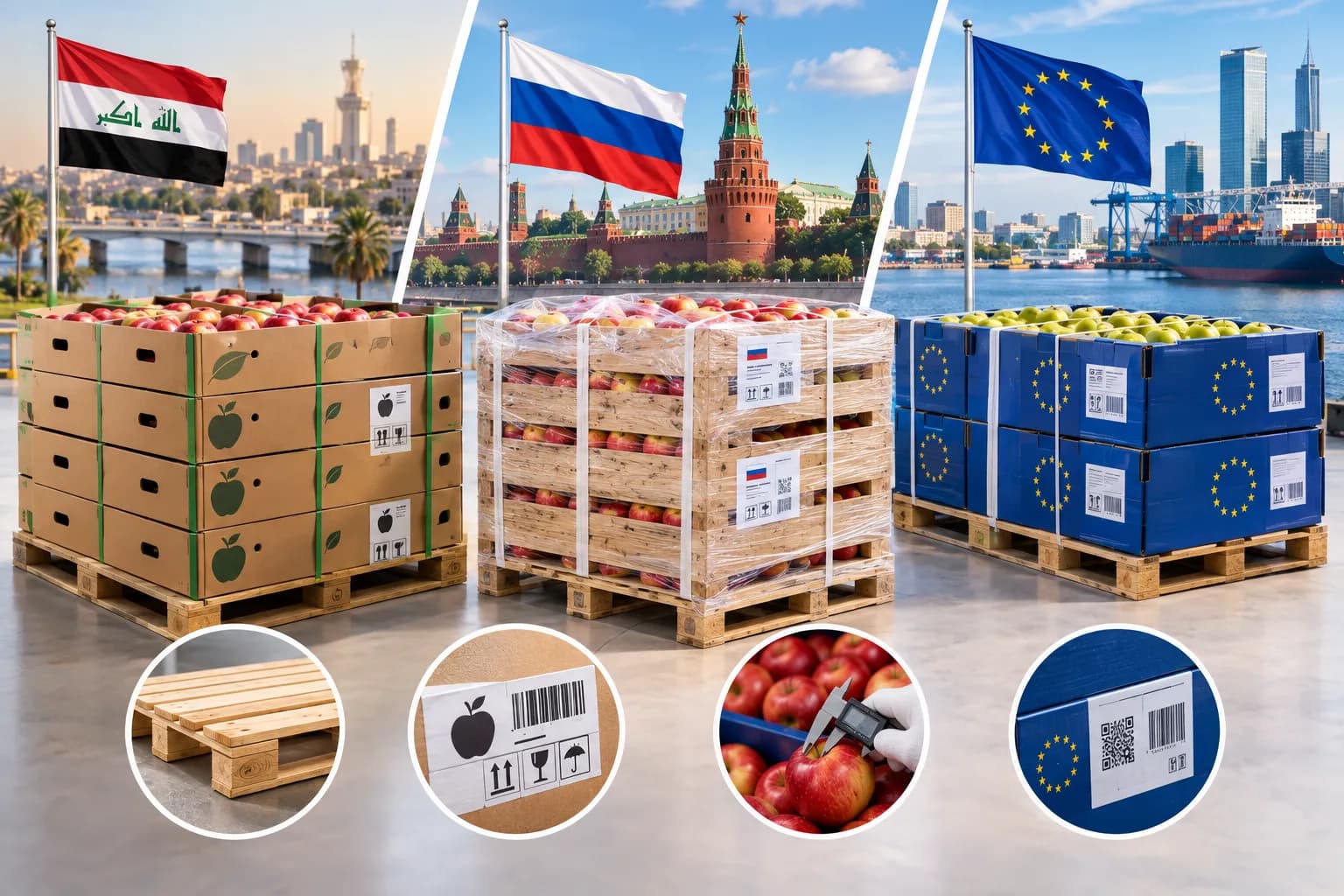
Any wooden pallet or crate crossing an international border falls under ISPM 15: the wood must be heat-treated (a minimum core temperature of 56آ°C for 30 minutes) or fumigated, then marked with the official IPPC stamp, commonly called the "wheat stamp." Plastic pallets, engineered wood (OSB), and cardboard are exempt from this requirement. Here's the part that catches people out: if even one wooden pallet lacks a valid stamp, the entire shipment can be held at customs — even if the fruit itself is perfect.
Quality grading: the UNECE standard
Many international markets, including European ones, use the United Nations Economic Commission for Europe (UNECE) standard for grading fresh produce. Under it, apples are split into three classes: Extra (superior quality, no defects), Class I (good quality, minor defects allowed), and Class II (marketable quality, larger defects allowed). Even if your destination country isn't formally a party to this standard, experienced buyers tend to use these same terms in contracts, so it's worth knowing them regardless.
Labeling requirements for Russia and the EAEU
For exports to Russia, the product label must be in Russian — a mandatory requirement under Eurasian Economic Union technical regulations (specifically TR CU 022/2011 on food labeling). The label needs to include the product name, country of origin, manufacturer's name, and storage conditions. The good news for fresh fruit exporters: unlike processed food, listing ingredients usually isn't required for unprocessed fresh produce.
Iraq's requirements: simpler, but not informal
Labeling and packaging requirements for Iraq are generally less formal and strict than Russia's or Europe's, but an Arabic-language label with the basics — country of origin, net weight, packing date — genuinely speeds up customs clearance and gives the buyer more confidence they're dealing with a professional supplier.
The mistake that stops an entire shipment
The most common mistake is using a wooden pallet without a valid ISPM 15 stamp. Since this is a customs requirement entirely separate from the fruit's own quality, a flawless shipment of fruit can get held up for this reason alone.
The practical takeaway
Before every new shipment into a new market, confirm the exact labeling and packaging requirements with the buyer or that country's customs representative. These requirements get updated every few years, and what was sufficient last year might not be this year.
Where Oriex fits in
On Oriex, packaging and labeling requirements for each destination market are made available to sellers as a reference, so a shipment is prepared to the buyer's country's standard from the start. If you export fruit, take a look at signing up on Oriex.