Most disputes between a fruit buyer and seller trace back to one simple question: if the shipment is damaged or held up in transit, whose problem is it? Incoterms exist specifically to settle that ahead of time.
What Incoterms actually are
Incoterms are a set of standardized international trade rules published by the International Chamber of Commerce (ICC). They define who's responsible for shipping, insurance, and customs clearance in an export deal, who pays for what, and — most importantly — the exact point where risk passes from seller to buyer. The current version is Incoterms 2020, with 11 rules in total.
Three common rules in sea-borne fruit trade
FOB — Free On Board
The seller's responsibility and costs run until the goods are loaded on board the vessel at the port of origin. From that moment, the buyer takes on the risk and the costs that follow — ocean freight, insurance, discharge.
CFR — Cost and Freight
The seller pays ocean freight to the destination port, but here's the part that trips people up: risk transfers the moment the goods go on board the vessel, not on arrival at the destination port. Insurance is the buyer's responsibility.
CIF — Cost, Insurance and Freight
Identical to CFR in how cost and risk are split, with one difference: the seller must also arrange cargo insurance, at a minimum level of cover (ICC-C). CIF is one of the most common terms in letter-of-credit transactions, since banks typically accept it or its equivalent.
Something most new exporters don't realize
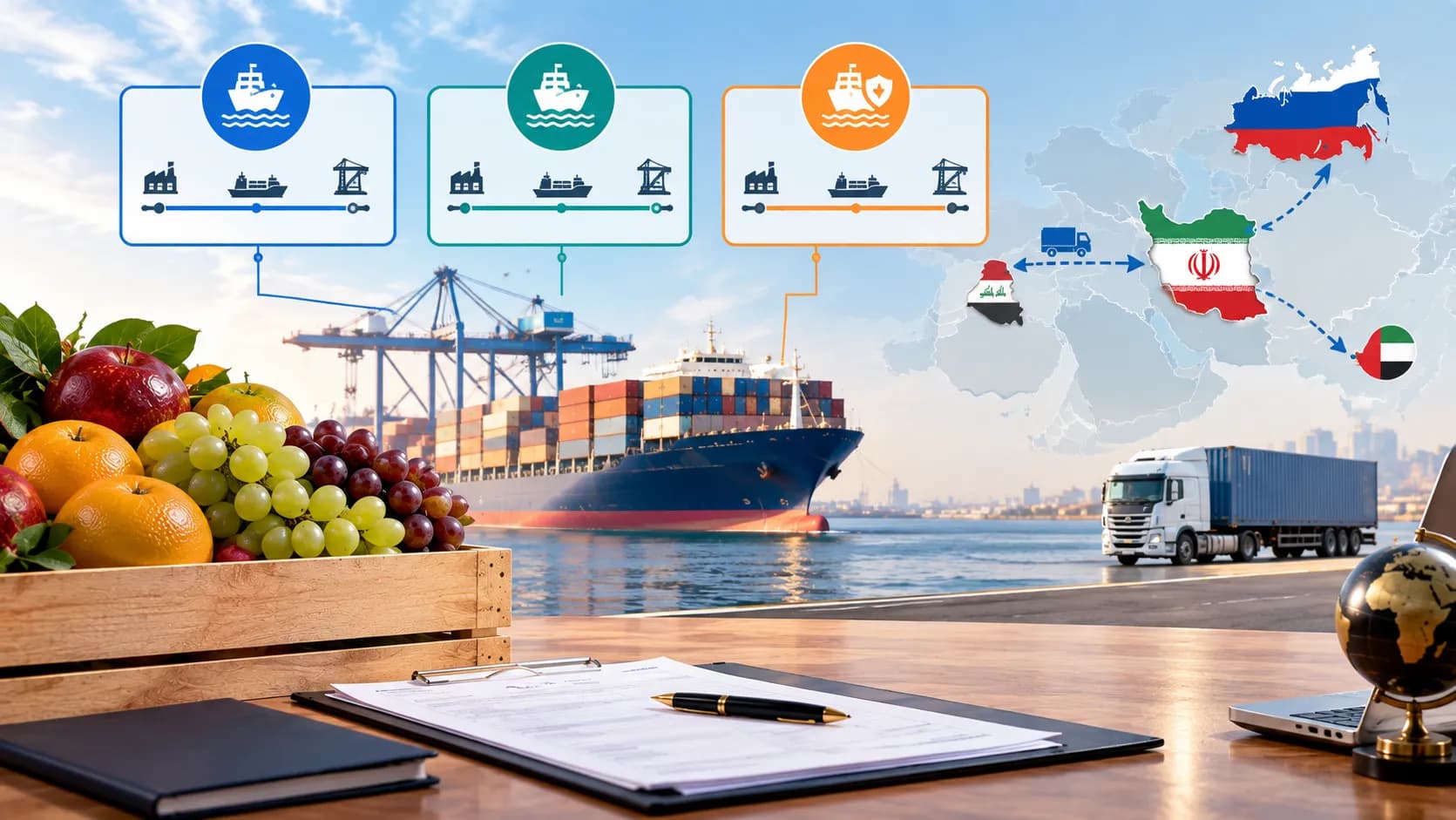
The ICC officially recommends that these three rules (FOB, CFR, CIF) be used only for bulk or conventional sea freight, not for containerized cargo. For containerized shipments — common in exports to Russia or the UAE — FCA, CPT, or CIP are recommended instead, because in container shipping the goods are usually handed to a terminal or container operator days before they're actually loaded on the vessel. The real risk-transfer point happens earlier than "on board the vessel."
The bigger issue for exports into Iraq: these rules don't apply at all
A large share of fruit exports from West Azerbaijan into Iraq moves by truck across a land border, not by sea. FOB, CFR, and CIF are defined exclusively for sea and inland waterway transport — they simply don't exist for road transport. For this kind of export, the relevant rules are FCA (Free Carrier), CPT (Carriage Paid To), or DAP (Delivered At Place), all of which work for road and multimodal transport. If you see a contract for a truck shipment to Iraq that uses "FOB," that's a sign the other side either doesn't know the terms or copied a generic template — worth a closer look.
Which term actually fits perishable goods better
Because fruit is perishable, any delay or damage in transit hits the value of the shipment directly. Many experienced fruit traders prefer risk to transfer earlier — at the port or loading point of origin — so that if something goes wrong mid-transit, proving liability and filing an insurance claim isn't more complicated than it needs to be. For a less experienced buyer, though, CIF can be the more comfortable option, since part of that responsibility stays with the seller.
The practical summary
Conventional (non-container) sea freight: FOB, CFR, or CIF work.
Containerized freight: consider FCA, CPT, or CIP instead.
Land export into Iraq: FCA, CPT, or DAP — not FOB/CFR/CIF.
Always pair the Incoterm with the exact named city or port in the contract or invoice ("FCA Urmia," not just the rule name).
Where Oriex fits in
On Oriex, every deal records the exact Incoterm and risk-transfer point, so both seller and buyer know from the start precisely where each party's responsibility ends. If you're negotiating an export deal, take a look at signing up on Oriex.